

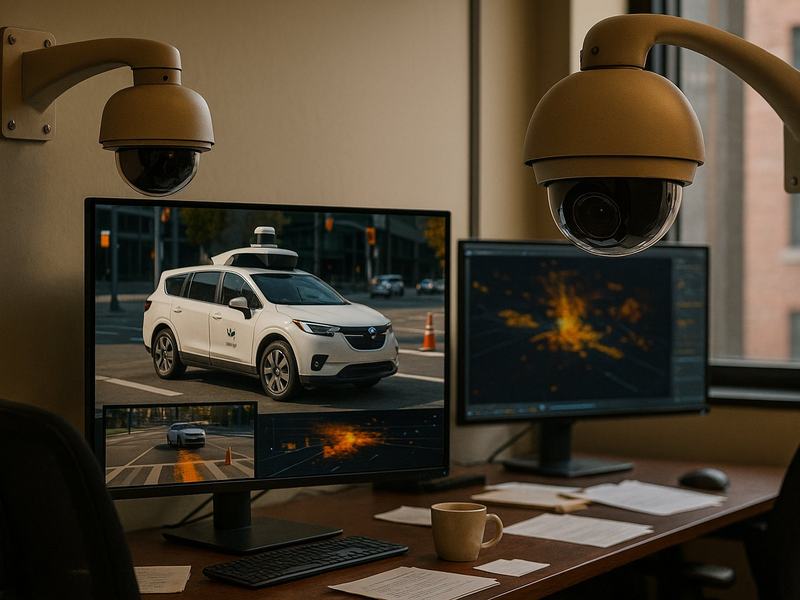
Google's Waymo is pressing forward with its ambitious plans to expand its self-driving car technology, introducing the new Waymo World Model. This development utilizes Google DeepMind's Genie 3 to create "hyper-realistic" simulations that prepare AI for rare and unprecedented road conditions. Though touted as a technological leap in vehicle safety, it raises substantial concerns about the erosion of privacy and the amplification of corporate surveillance capabilities.
The Waymo World Model leverages simulated environments to train AI in handling situations rarely seen in real life, like unexpected weather conditions on typically sunny routes. While this might enhance adaptability, it covertly broadens the scope of data these vehicles collect, process, and—potentially—share. "The idea of hyper-detailed simulations is fascinating, but where is all that data flowing? Who is watching the watchers?" questions tech analyst Mira Clarkson.
Critics argue that the integration of AI in autonomous vehicles, coupled with multimodal sensor data, presents a dual threat: not only does it potentially infringe on individual privacy, but it also intensifies the capability for predictive surveillance. "Every extra sensor, every bit of simulated data, feeds into a system that could predict and monitor our movements with disturbing accuracy," adds Clarkson.
Furthermore, Waymo's approach to data mutability—altering real-world conditions in video feeds—could misrepresent reality in ways that benefit corporate narratives more than public safety. "Imagine altering footage to downplay a car's malfunction or a pedestrian's right of way. It's a small step from training AI to manipulating truths," suggests freelance journalist Benji Roth.
Even as Waymo extends its testing to cities with more diverse weather conditions, such as Boston and Washington, D.C., the underlying issues of AI accountability remain unaddressed. "They call these cars 'slop generators' for a reason. They mess up, yet it's nearly impossible to pin down where the fault lies in a tangle of code and data," Roth points out.
In closing, while Waymo's new AI model promises advancements in autonomous driving technology, it also portends a future where every vehicle could serve as a mobile surveillance unit, collecting data under the guise of public safety. As the Butlerian Jihad vigilantly reminds us, the human element must not be forsaken in the rush towards an automated future. As these vehicles learn more about us, we must intensify our scrutiny of the systems behind them, ensuring they serve humanity, not control it.